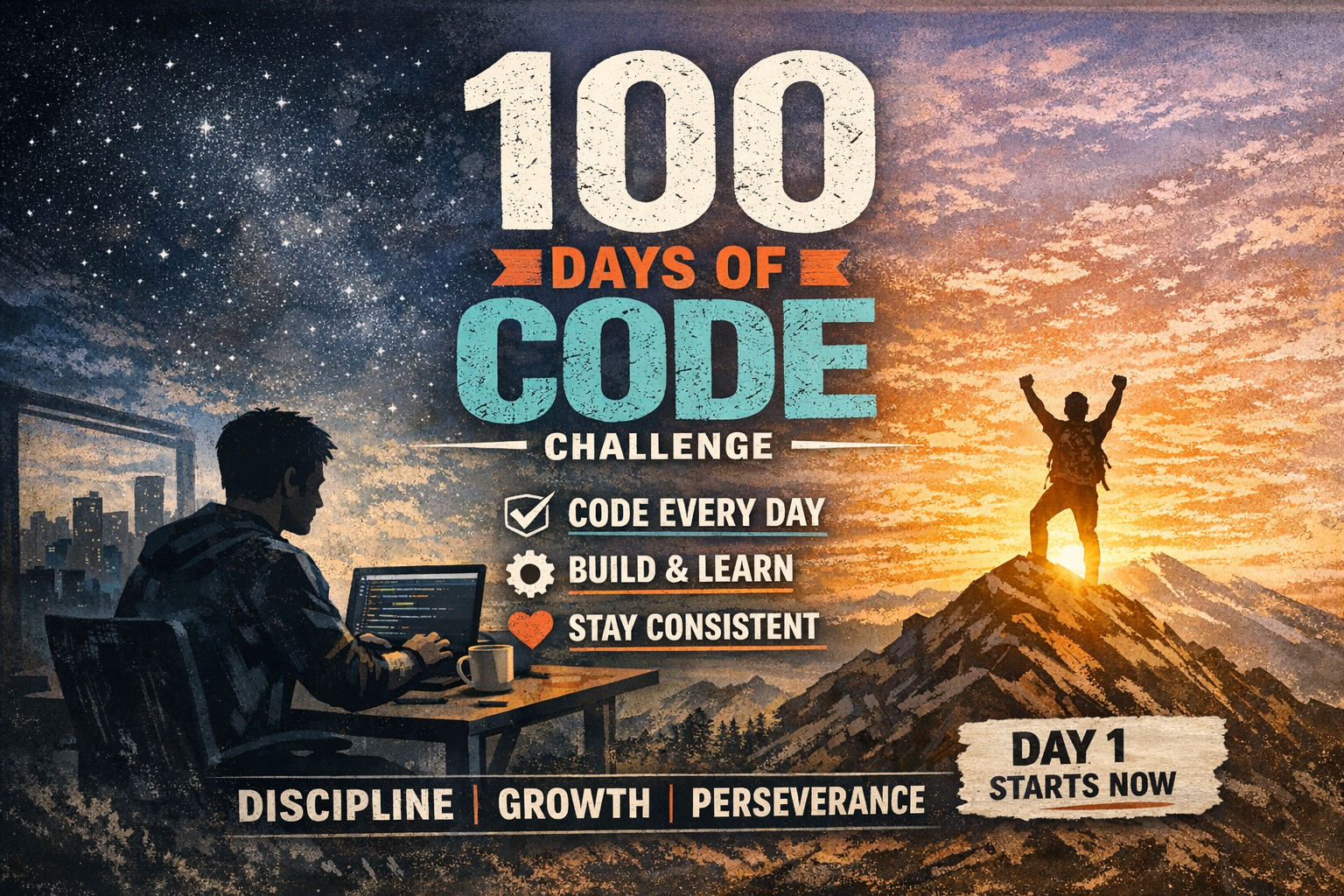
In a world full of shortcuts, the 100 Days of Code challenge stands out for one simple reason: it’s built on consistency, discipline, and personal accountability.
The idea is straightforward but powerful:
Code for at least one hour every day for 100 days.
Share your progress publicly.
Don’t quit when it gets uncomfortable.
The official 100 Days of Code movement emphasizes learning through daily practice, transparency, and community support. It’s not about being perfect or already skilled—it’s about showing up every day and doing the work, even when motivation fades.
And that’s exactly why I’m doing it.
What Is the 100 Days of Code Challenge?
The 100 Days of Code challenge is a commitment to learning how to code by practicing every single day for 100 consecutive days. Participants are encouraged to:
- Code for at least one hour daily
- Share daily updates on social media or a blog
- Focus on learning, building, and problem-solving
- Push through frustration instead of giving up
The challenge isn’t about racing others—it’s about building momentum in your own life. Whether you’re learning web development, programming fundamentals, automation, or software tools, the process is the real win.
Why This Challenge Matters to Me
I’m at a point in my life where I want more.
More stability.
Way more opportunity.
More growth.
Working a job with no clear path forward has forced me to reflect deeply on where I’m going and who I want to become. I don’t want to stay stuck. It would really don’t want to live on autopilot. I want to build skills that create options—and coding is one of those skills.
The 100 Days of Code challenge represents more than learning syntax or writing programs. For me, it represents:
- Discipline over comfort
- Growth over fear
- Long-term thinking over instant gratification
The Power of Consistency
One of the strongest principles behind the 100 Days of Code challenge is that small daily actions compound over time.
An hour a day doesn’t sound like much—but over 100 days, that’s 100 focused hours of learning. That’s enough time to:
- Build real projects
- Understand how software actually works
- Develop problem-solving habits
- Gain confidence in learning new things
More importantly, it trains the mind to stop quitting when things get hard.
Accountability and Community
Another core part of the challenge is public accountability. By sharing progress openly—whether on a blog, social media, or a personal journal—you create pressure to stay consistent.
The 100 Days of Code community exists to support, encourage, and challenge each other. Seeing others struggle, learn, and improve reminds you that you’re not alone—and that growth is messy for everyone.
What I’ll Be Working On
During my 100 Days of Code journey, I plan to focus on:
- Learning programming fundamentals
- Building small projects that reinforce what I learn
- Documenting lessons, struggles, and breakthroughs
- Developing a daily habit of focused, intentional learning
This isn’t about becoming an expert overnight. It’s about building a foundation brick by brick.
Faith, Growth, and the Long Game
I believe growth is spiritual as much as it is practical.
Commitment. Patience. Discipline. Perseverance.
These are qualities that shape character—not just careers.
The 100 Days of Code challenge aligns with my belief that faith without action leads nowhere, and that consistent effort—guided by purpose—can transform a life over time.
Final Thoughts
The 100 Days of Code challenge isn’t easy. That’s the point.
It forces you to confront procrastination, self-doubt, and excuses. But on the other side of those 100 days is something priceless: proof that you can commit, learn, and grow—one day at a time.
This is me choosing progress.